Wednesday, March 7, 2012

Scrape the bottom of the bucket


to choose from what is left over, or to select from among the worst. There is the idea of settling for 2nd best because you have no other options or you may also be desperate in your decision-making.
Man: Wow!     “Talk about…”: to emphasize something, especially when criticizing or complaining, e.g.: “Talk about bad luck!”

1. I have watched so many movies that it’s difficult to find a good movie to rent or download, so these days I’ve been scraping the bottom of the bucket and watching movies that I normally wouldn’t consider. It’s amazing what we will settle for when we are desperate for entertainment or really bored! Recently I watched the movie, “Brokeback Mountain”. Talk about scraping the bottom of the bucket!

2. Don’t you feel sometimes that we’re scraping the bottom of the barrel when it comes time to vote for a presidential candidate, mayor or governor? Many times it’s a case of choosing from the least worst. Don’t you ask yourself, “Man, where do they find these people!?”

3. When you buy an air ticket at the last minute, you may have to scrape the bottom of the bucket… you will probably not get the seats of your choice, and may not be able to sit together with your friends or family because you have to accept the seats that are left over. You will likely sit right next to the toilet!

Monday, March 5, 2012

Set up

The “Huns” are a tribe of barbarians who are the enemies 
of the imaginary kingdom of Id.
To set up: to construct, to configure (electronics), to assemble, to establish (create) something, to erect or to organize.

1. When you want to set up (establish) your own business, you will probably need some capital (money) to start with… at least for advertising your services. You will also need a game plan - and more than that you, will need persistence.

2. To “set up shop” is an idiomatic expression which means to establish a business or an organization. When a company of any sort sets up shop in a foreign country because the exchange rate is more favorable (and thus the labor is cheaper), we call this outsourcing. Do you know of any companies that outsource their manufacturing and set up shop overseas?

3.  It is becoming easier and easier to set up (create) a blog page. Google is making the interface really easy for new bloggers to figure out exactly what to do step by step.

4. Before any band plays music, they need to set up the drums, microphones, amplifiers etc.

Wednesday, February 29, 2012

Better off

                    Bug: Insect         Appalling: Terrible/ Shocking

If you are “better off”, it means that you are in a better or more favorable position or situation. If you are better off with (something) or doing (something), it is a more preferable scenario when compared to other options or alternatives.

1. There is an expression which says, “Ignorance is bliss” (Ignorance is happiness). It basically means that some things we are better off not knowing. It’s the same as saying, “What you don’t know can’t hurt you.” Do you honestly think you would be better off not knowing something, or is it always better to know?

2.  If you had to choose between losing your sight and losing your hearing, which would it be? Would you be better off being able to see or being able to hear? In the latest episode of Dr. House entitled, “Love is blind”, a blind patient is faced with a decision: he can receive treatment and lose his hearing or he could refuse the treatment and die. Initially he thought it was better off to die if he were both blind and deaf. Look at this video clip I put together: http://www.youtube.com/watch?v=86oAvp49WEg

3. Our environment will be better off when we start using alternative forms of energy more and more.

4. I have a cable TV subscription, but in Brazil all of my favorite TV series are shown at least 2 to 3 weeks after they come out in the US. It’s better off downloading them and watching them immediately, than having to wait so long - even if it’s considered piracy. What do you think?

Tuesday, February 28, 2012

Go through


Stand: to tolerate/ put up with (only used in the negative sense): 
Ex. I can’t stand losing.

If you “go through” something, it is the same as saying to experience something. Generally this phrasal verb is used to talk about difficult or negative experiences. It can also simply mean to pass through something.

1.  If someone “goes through hell and high water”, it means that they pass through many severe difficulties. Most women go through hell and high water when they are pregnant. I don’t doubt it.

2. Many people go through “culture shock” when they move to a foreign country. Everything is so different to what they are used to (accustomed to), and it takes time to adapt to their new environment. 

3. Can you imagine what people in prison go through, being isolated from the rest of the world? I have no intention of finding out (discovering). I don’t want to go there!

4. The Middle East is still going through radical changes, and I imagine it will be a long hard process with no quick fixes (easy solutions). They still have a “long road ahead of them”.

Sunday, February 26, 2012

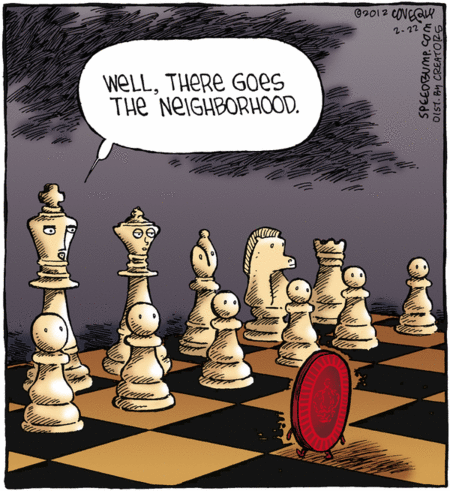
There goes...


When we say, “There goes…” it means that you will lose something… your chance of success is lost or at risk. Something has frustrated your plans. It can also be the end of something.

1. There goes the neighborhood is an expression used in a social context, where an affluent (wealthy) neighborhood starts to go downhill because of some (perceived) negative influences: People of a different social class or ethnicity move into a neighborhood and the old way of life cannot be preserved. The residents of the neighborhood will lose their comfortable way of life. Their ideal world has been invaded. In this sense it is derogatory (negative and judgmental). It could be a racist or classist comment… but on the other hand, perhaps a new bar has just opened on your street, which may attract some negative influences, and you can say, “There goes the neighborhood”.

2. German Chancellor Angela Merkel said that Greece should raise its retirement age, which at the moment is somewhere between 59 and 61 years old. The Greek government now plans to raise it to 63 years old by 2015. Many Greeks are not happy about this, for obvious reasons, and I’m sure many people are shaking their heads and saying, “There goes my early retirement!” Germany raised its retirement age several years ago from 65 to 67.

3. With all of the drama surrounding the PIPA and SOPA (Stop Online Piracy Act) acts, many people are saying, “There goes the internet as we know it”. People are now becoming more careful about infringing on (violating) copyright laws… so things are definitely changing. Right now, I am able to use copyrighted comic strips on my blog for teaching purposes, without asking the copyright holder (owner) for permission. This is called “fair use”. Examples of fair use include using copyrighted material for commentary, criticism, news reporting, research and teaching. SOPA threatens the concept of fair use.

Friday, February 24, 2012

Stick to (something)


To follow, continue or persist with something without changing it, giving up or getting distracted.

1. As with anything, when it comes to learning English, you need to stick to it and keep working at it. If you persist long enough you will reach your goals. As they say, “Practice makes perfect”.

2. If someone sticks to their guns, they keep their position even if people attack or criticize them. Muamar Kadafi stuck to his guns even when the whole world was against him. Did that make him a madman or did it make him a martyr?

3.  Do you know anyone who finds it difficult to stick to the point – someone who can’t focus on one point and who gets distracted and rambles on (talks and talks) about everything under the sun?

4. Stick-to-itiveness is a noun which comes from the phrase “stick to it”. If you have stick-to-itiveness, you have “dogged determination”, incredible perseverance or tenacity. You don’t give up easily. You stick to something until it is completed.

Wednesday, February 22, 2012

The greatest thing since sliced bread


When someone says that someone or something is “the best/ greatest thing since sliced bread”, they think that it or that person is cool, great, fantastic, incredible, awesome etc. It’s also a relatively recent invention or innovation that is likely to significantly improve people's lives.
Sliced bread is a loaf of bread which has been pre-sliced and packaged for convenience. It was first sold in 1928, advertised as "the greatest forward step in the baking industry since bread was wrapped." This led to the popular phrase, "the greatest thing since sliced bread". - Wikipedia

1. Take a look at this keyboard food tray. It prevents you from getting crumbs on or spilling coffee on your keyboard while you’re eating at your desktop. Would this kind of gadget be useful to you? For people who need to eat or snack on the job, it’s quite literally the greatest thing since sliced bread.

2.  Recently someone recommended a free piece of software that automatically adjusts the contrast of your computer screen at night to make it easier on your eyes. “F.lux” is the best thing since sliced bread! Here’s the site: http://stereopsis.com/flux

3. Do you think twitter and Facebook are the greatest thing since sliced bread, or do you think that social media is the biggest time-waster since the invention of the TV?

4. I think pen drives (USBs) are the best thing since sliced bread. Who doesn’t have one nowadays?

Friday, February 17, 2012

Be used to VS used to

-> “Get/be used to”:  
With the verbs “get” or “to BE”, used to is an adjective in the present: “I AM used to…” is the same as saying, “I AM accustomed to…”
* When followed by a verb, the verb must be in the –ing form


1.  I live in an apartment on a busy road. In the first week it was difficult to get to sleep, but now we’re used to the noise from the traffic. It doesn’t bother us in the least.

2. Here in the Northeast of Brazil, the heat is really oppressive at times. If you can get used to the climate though, it’s absolutely worth it – just for the fantastic beaches, and of course a year-round summer.

3. I’m used to teaching English classes early in the morning and late in the evening. The great thing about teaching from home is that I’m able to take a nap just about every afternoon… I’m used to having a flexible lifestyle.
 

->“Used to”:  
WITHOUT the verb “get” or “to be”, used to is a verb in the past tense: something you used to do regularly in the past as a routine/ habit that you don't do anymore.
*Also used with states (i.e. a state of mind/ state of being)


1. I used to work on the cruise ships as a photographer 11 years ago. It was my dream job until I decided to live and work in Latin America.

2. I used to teach English at some large English schools in Central America. When I came to Brazil I decided to focus exclusively on teaching private English classes from home. Since then I’ve never looked back.