Thursday, April 12, 2012

Make do (with)


If you “make do” with something, you have to use what you have at the moment; you have to make a plan with what is available - even if it is not the best or ideal. You improvise until you can have what you want later.

1. I would love to have air conditioning in our apartment, but for now we will have to make do with fans.

2.  Before I got my first computer I had to make do with going to an internet cafĂ© and also storing all of my important information on a USB/ pen drive.

3. If you don’t have a car, you need to make do with public transportation or getting lifts (rides) from friends.

4. When you make do with what you have, you are being resourceful. You use your creativity and ingenuity to improve your situation when you have limited resources. During my first months in Brazil, we didn’t have a washing machine, so I used to put all of our clothes into a big plastic tub, climb into the tub and run on the spot, churning the clothes with my feet. I had to make do with a plastic tub until we could afford a washing machine.

Wednesday, April 4, 2012

Settle for


When you “settle for” anything, you are accepting second best or something that is inferior to what you really wanted – because you have limited options, or what you want is not possible.

1.  I would really love a house right on the beach one day - but if not possible I will have to settle for renting an apartment with a sea view.

2. If I ask for a pineapple juice when I am at a restaurant, and they don’t have any, I usually settle for an orange juice.

3. If you can’t get into the course at university that you really want, you may have to settle for something similar… or even consider studying another career. Sometimes life doesn’t work out the way we want or expect.

4. What brand names do you have to settle for because the product that you want is either not available or much more expensive?

Wednesday, March 7, 2012

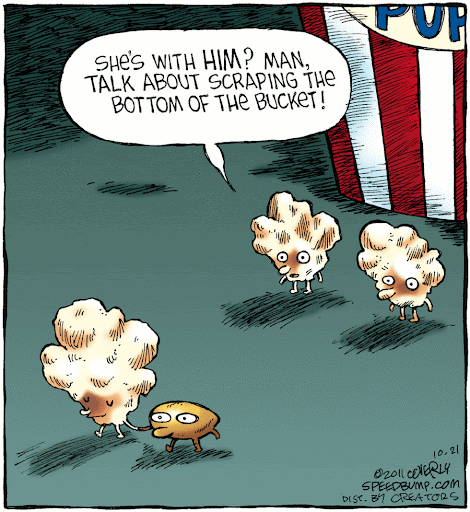
Scrape the bottom of the bucket


to choose from what is left over, or to select from among the worst. There is the idea of settling for 2nd best because you have no other options or you may also be desperate in your decision-making.
Man: Wow!     “Talk about…”: to emphasize something, especially when criticizing or complaining, e.g.: “Talk about bad luck!”

1. I have watched so many movies that it’s difficult to find a good movie to rent or download, so these days I’ve been scraping the bottom of the bucket and watching movies that I normally wouldn’t consider. It’s amazing what we will settle for when we are desperate for entertainment or really bored! Recently I watched the movie, “Brokeback Mountain”. Talk about scraping the bottom of the bucket!

2. Don’t you feel sometimes that we’re scraping the bottom of the barrel when it comes time to vote for a presidential candidate, mayor or governor? Many times it’s a case of choosing from the least worst. Don’t you ask yourself, “Man, where do they find these people!?”

3. When you buy an air ticket at the last minute, you may have to scrape the bottom of the bucket… you will probably not get the seats of your choice, and may not be able to sit together with your friends or family because you have to accept the seats that are left over. You will likely sit right next to the toilet!

Monday, March 5, 2012

Set up

The “Huns” are a tribe of barbarians who are the enemies 
of the imaginary kingdom of Id.
To set up: to construct, to configure (electronics), to assemble, to establish (create) something, to erect or to organize.

1. When you want to set up (establish) your own business, you will probably need some capital (money) to start with… at least for advertising your services. You will also need a game plan - and more than that you, will need persistence.

2. To “set up shop” is an idiomatic expression which means to establish a business or an organization. When a company of any sort sets up shop in a foreign country because the exchange rate is more favorable (and thus the labor is cheaper), we call this outsourcing. Do you know of any companies that outsource their manufacturing and set up shop overseas?

3.  It is becoming easier and easier to set up (create) a blog page. Google is making the interface really easy for new bloggers to figure out exactly what to do step by step.

4. Before any band plays music, they need to set up the drums, microphones, amplifiers etc.

Wednesday, February 29, 2012

Better off

                    Bug: Insect         Appalling: Terrible/ Shocking

If you are “better off”, it means that you are in a better or more favorable position or situation. If you are better off with (something) or doing (something), it is a more preferable scenario when compared to other options or alternatives.

1. There is an expression which says, “Ignorance is bliss” (Ignorance is happiness). It basically means that some things we are better off not knowing. It’s the same as saying, “What you don’t know can’t hurt you.” Do you honestly think you would be better off not knowing something, or is it always better to know?

2.  If you had to choose between losing your sight and losing your hearing, which would it be? Would you be better off being able to see or being able to hear? In the latest episode of Dr. House entitled, “Love is blind”, a blind patient is faced with a decision: he can receive treatment and lose his hearing or he could refuse the treatment and die. Initially he thought it was better off to die if he were both blind and deaf. Look at this video clip I put together: http://www.youtube.com/watch?v=86oAvp49WEg

3. Our environment will be better off when we start using alternative forms of energy more and more.

4. I have a cable TV subscription, but in Brazil all of my favorite TV series are shown at least 2 to 3 weeks after they come out in the US. It’s better off downloading them and watching them immediately, than having to wait so long - even if it’s considered piracy. What do you think?

Tuesday, February 28, 2012

Go through


Stand: to tolerate/ put up with (only used in the negative sense): 
Ex. I can’t stand losing.

If you “go through” something, it is the same as saying to experience something. Generally this phrasal verb is used to talk about difficult or negative experiences. It can also simply mean to pass through something.

1.  If someone “goes through hell and high water”, it means that they pass through many severe difficulties. Most women go through hell and high water when they are pregnant. I don’t doubt it.

2. Many people go through “culture shock” when they move to a foreign country. Everything is so different to what they are used to (accustomed to), and it takes time to adapt to their new environment. 

3. Can you imagine what people in prison go through, being isolated from the rest of the world? I have no intention of finding out (discovering). I don’t want to go there!

4. The Middle East is still going through radical changes, and I imagine it will be a long hard process with no quick fixes (easy solutions). They still have a “long road ahead of them”.

Sunday, February 26, 2012

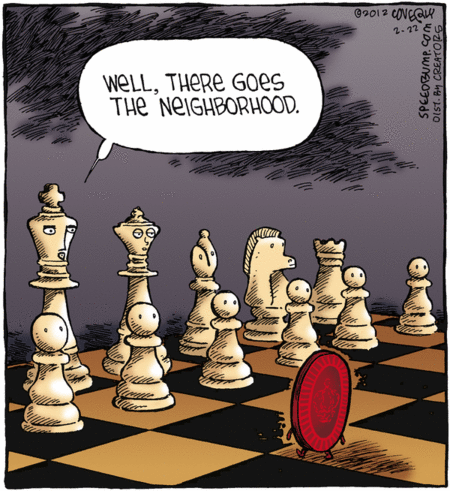
There goes...


When we say, “There goes…” it means that you will lose something… your chance of success is lost or at risk. Something has frustrated your plans. It can also be the end of something.

1. There goes the neighborhood is an expression used in a social context, where an affluent (wealthy) neighborhood starts to go downhill because of some (perceived) negative influences: People of a different social class or ethnicity move into a neighborhood and the old way of life cannot be preserved. The residents of the neighborhood will lose their comfortable way of life. Their ideal world has been invaded. In this sense it is derogatory (negative and judgmental). It could be a racist or classist comment… but on the other hand, perhaps a new bar has just opened on your street, which may attract some negative influences, and you can say, “There goes the neighborhood”.

2. German Chancellor Angela Merkel said that Greece should raise its retirement age, which at the moment is somewhere between 59 and 61 years old. The Greek government now plans to raise it to 63 years old by 2015. Many Greeks are not happy about this, for obvious reasons, and I’m sure many people are shaking their heads and saying, “There goes my early retirement!” Germany raised its retirement age several years ago from 65 to 67.

3. With all of the drama surrounding the PIPA and SOPA (Stop Online Piracy Act) acts, many people are saying, “There goes the internet as we know it”. People are now becoming more careful about infringing on (violating) copyright laws… so things are definitely changing. Right now, I am able to use copyrighted comic strips on my blog for teaching purposes, without asking the copyright holder (owner) for permission. This is called “fair use”. Examples of fair use include using copyrighted material for commentary, criticism, news reporting, research and teaching. SOPA threatens the concept of fair use.

Friday, February 24, 2012

Stick to (something)


To follow, continue or persist with something without changing it, giving up or getting distracted.

1. As with anything, when it comes to learning English, you need to stick to it and keep working at it. If you persist long enough you will reach your goals. As they say, “Practice makes perfect”.

2. If someone sticks to their guns, they keep their position even if people attack or criticize them. Muamar Kadafi stuck to his guns even when the whole world was against him. Did that make him a madman or did it make him a martyr?

3.  Do you know anyone who finds it difficult to stick to the point – someone who can’t focus on one point and who gets distracted and rambles on (talks and talks) about everything under the sun?

4. Stick-to-itiveness is a noun which comes from the phrase “stick to it”. If you have stick-to-itiveness, you have “dogged determination”, incredible perseverance or tenacity. You don’t give up easily. You stick to something until it is completed.