Monday, May 21, 2018

Be able to…


If you are able to do something, you have the ability to do it.
 (conseguir fazer)

1. How long are you able to maintain a consistent daily routine without giving up? Have you ever heard of Jerry Seinfeld’s strategy called, “Don’t break the chain!”?

2. Some Brazilians take oaths (promises), which usually involves abstaining from something for a long period of time, on the condition that they or a family member gets what they want - for example, passing a public contest. Would you be able to stop eating, say, bread for 4 or 5 years?

3. Very few people are able to admit that they are wrong. It’s not easy to swallow your pride.

4. My daughter is still not able to whistle. That’s only to be expected for her age. Is there anything you‘re still not able to do that most other people can do? I’m still not able to speak Korean.

5. Is there any process you‘re not able to currently complete because of bureaucracy? Have you come up against any dead ends and cannot continue moving forward?

6. Many Brazilians from the Northeast are not able to pronounce the letter “R” as they do in the South of Brazil… or as we do in English. What sounds in English are you not able to reproduce yet?

7. What things are you able to do that others can’t, because you’re highly skilled/ trained in that area? I’m able to play the harmonica pretty well and manipulate the CSS of blogs in general.

8. I’m not able to cook well, but I am planning to improve! What are you unable to do right now that you’re planning to get better at?

9. I am able to work on anything (or watch anything) for hours on end. What are you able to do for a number of hours without getting distracted, tired or giving up?

10. I was never able to finish my Math exams on time. I was not that bad… just a little slow. In what area of knowledge are you unable to process information quickly?

Tuesday, April 17, 2018

Learn (something) the hard way/ Live and learn

(Vivendo e aprendendo)

1. When you don’t pay a loan or for your credit card installments by the due date, the bank charges you interest. After a month they start charging interest on the interest. Pretty soon you can land yourself in unmanageable debt. Has that ever happened to you before? We live and learn.

2. Do you generally learn from your own mistakes and do better the next time, or do you keep making the same old mistakes? Sometimes mistakes are unavoidable - but in many such situations I tell myself, “You live and learn“.

3. One day in El Salvador, Central America, I drank water directly from the tap. I was too thirsty to care at the time… but I ended up getting typhoid fever shortly thereafter as a result. Sometimes we have to learn the hard way!

4. Have you ever gotten a traffic fine? If so, what was it for? Have you ever gone the wrong way down a one-way street, talked on your cellphone while driving or any other infraction? Sometimes the only way we learn is when we feel it in the pocket - when we get a hefty fine. We learn the hard way.

5. Not everyone can be trusted and not everyone has good intentions. Unfortunately most of us find this out the hard way.

6. Sometimes we learn more by failing and picking ourselves up and trying again. Often we live and learn through trial and error. Can you remember any lesson you learned the hard way?

7. The only way to really know what an ice-cream headache is like is to eat too much and suffer the consequences. We live and learn!

8. When I first came to Fortaleza, I was not prepared for the strength of the sun and the viciousness of the mosquitoes. I learned the hard way to use sun block and insect repellent.

9. After a month of unregulated use of any service, such as long-distance calls on a cellphone, air conditioning (higher electricity usage), etc., one may be shocked to receive a much higher bill than expected. We can then adjust our habits thereafter. We live and learn.

10. If one does not exercise or have a more-or-less healthy diet, it’s a matter of time before health problems start cropping up. If you don’t drink enough water, that may lead to kidney stones. The lesson is so painful, I am sure, that one will immediately increase their water intake to avoid the same happening in the future. We live and learn.

Thursday, October 2, 2014

One out of...

One way to report statistics is to say, “One out of xxx people…”,  “One out of every xxx people…”,  “One in xxx people…” or “One in every xxx people…”
Another possibility: “For every 4 people in the world there is 1 Chinese person.”

1.      Worldwide, around 265 people are born every minute and 115 people die, for a net increase in population of 150 people every minute. So for every 2 people that are born, 1 dies.

2.      In a study of 3,000 people who made New Year's resolutions in 2007, only 12% stuck to them. The resolution with the greatest chance of success was "to enjoy life more". This means that only one in every 8 people stuck to their resolutions.

3.      Half of the population of Uganda is under 15 years of age… which means that 1 out of every 2 people is under the age of 15.

4.      One in every 10 YouTube videos is available in HD (High Definition) and 3 out of every 10  YouTube users are from the USA. 7 out of 10 users are outside of the USA.

5.      By 2030, the UN Population Fund says the number of city inhabitants will be over five billion, or 60% of world population. That’s 3 in 5 people!

6.      One in three Americans will be diagnosed with cancer, often before the age of 65.

7.      The countries with the highest populations of native English speakers are, in descending order: United States (215 million), United Kingdom (61 million), Canada (18.2 million), Australia (15.5 million), Nigeria (4 million), Ireland (3.8 million), South Africa (3.7 million), and New Zealand (3.6 million) - 2006 Census. Three out of every 4 English speakers are now non-native speakers.


8.      In New Zealand there are currently 40 million sheep and 4 million people. So there are 10 sheep for every one person. In 1982 it used to be 22 sheep per person. 

Tuesday, August 19, 2014

NOUN + THING

When we use a "NOUN + THING" combination, we are saying that the topic at hand has to do with that noun. It is connected to that noun. It is related to that noun. In the comic strip one shark comments that his going in circles and getting nauseous must be related to/ have to do with his age. It's a very common and easy way to connect ideas.

1. When women do not want to explain what they're talking about or joking about, they will say to guys, "It's a girl thing". It may be private, personal, embarrassing or difficult to explain. When a woman says that, do you get curious… or do you lose interest?

2. Likewise, when men don't have the patience to explain why they like watching football, going fishing or having a beer with their friends… They say "It's a guy thing". Are there certain things that you don't have the time or patience to explain because you think people won't understand anyway?

3. When a conversation is interrupted by a telephone call, once the person is finished chatting, if the call was from a colleague at work and was very technical, normally we explain to the other people, "It's a work thing". That way no one will think it is interesting and will probably lose their curiosity. Do you say something similar in your own language?

4. Anything we find difficult to relate to or explain, we use the "noun + thing" construct. For example, "It's a teenage thing." Are you totally out of touch with teenagers these days… or do you understand the trends and issues they are facing?

5. Often parents say to the children, "Don't worryIt's an adult thing." Do you now understand all the things your parents wouldn't explain to you when you were a child? Would those things have been difficult to understand when you were younger?

Wednesday, August 13, 2014

Supposed to...

If something is supposed to be a certain way or happen in a certain way, it “should” be or happen that way. It is “meant to” be like that. We are talking about the intended purpose or result.
-> É para; Era para/ deveria/ supostamente/ pressupõe-se/ se supõe que/ é suposto para


1.      I am supposed to brush my daughter’s teeth before she goes to bed, but sometimes she falls asleep before I can brush them. What can I do?!

2.      The Metro in Fortaleza was supposed to have been completed years ago. What excuse did the local government give?  Hopefully it gets completed soon!

3.      According to the Mayan calendar, the world was supposed to end on December 21st 2012. NASA said that the solar flares that were supposed to hit the earth in 2012 would hit us in 2013.

4.      In many cultures, the groom is not supposed to see the bride’s wedding dress before the ceremony. What is not supposed to happen according to superstitions related to weddings in your own country?

5.      We are not supposed to download movies etc. from the internet… but we do it anyways, with little to no consequence. Personally, when it comes to the ethics of pirating, it is a very “gray area” for me.   

6.      The United Nations is supposed to be an international body that arbitrates in important matters, especially crises… however, it’s a complicated affair trying to come to a resolution, because “too many cooks spoil the broth” – too many opinions make it extremely bureaucratic, if not impossible, to reach a consensus.

7.      We are supposed to “eject” the devices connected to our computers before pulling them out… most commonly with USB devices/ pen drives. Honestly, what will happen if we don’t go through this process?

8.      I know that I am supposed to separate my “whites” and “coloreds” when washing clothes, but I think it makes little difference when we’re doing a “cold wash”, so I bundle everything in together, “no mess no fuss” – no problem. What things are you supposed to do that you often ignore on purpose?

9.      We are supposed to throw trash in trash cans/ rubbish bins and not litter (throw trash on the floor in public). Someone who does this is called a “litterbug”. Be honest… have you littered recently?


10.  I was supposed to become a photographer for the National Geographic (It was my destiny in the abstract sense). What were you supposed to do with your life? Do you have any regrets? 

Tuesday, August 5, 2014

When... (future)

When we talk about the future using “when + verb”, it’s not necessary to use “will”… we simply use the simple tense of the verb.

1.      When I am rich, I’m going to buy a little beach house somewhere along the coast in Ceará.

2.      Have you thought about what you would like to do one day when you retire? Would you like to take up a new hobby, invest in a business… or just relax?

3.      When my daughter is a teenager I will need to get some good parenting advice from others who have “been there before”. I have another 9 years more or less to prepare myself.

4.      One day when I visit Rio de Janeiro, I’d like to experience all of the tourist attractions. What would you say is the number one thing that everyone has to do when they go to Rio?

5.      When I get my Brazilian Citizenship, I will be able to travel throughout South America without a passport. If only the traveling itself weren’t so expensive!


6.      When we have a new governor and mayor, do you think they will do a better job than the current ones?

7.      It will be a sad day when Nelson Mandela dies. He is 94 years old this year… and “time waits for no man”. When you die, what would you like people to say or think about you? (This example was written months before his death)


8.  When I get a credit card I will be able to accumulate miles. The more I spend, the more miles I’ll get!

Tuesday, July 29, 2014

Just because... it doesn't mean...

Just because... it doesn't mean..." is an expression  we use to look beyond the obvious and expected. It shows us that there are other alternatives, possibilities, options or outcomes.


7. Getting divorced just because you don't love a man is almost as silly as getting married just because you do. - Zsa Zsa Gabor

Tuesday, July 22, 2014

A "nice touch"

A nice touch is a small detail that improves the appearance/ atmosphere/ quality/ comfort/ design/ idea, etc. of something.  

1. Do you pay attention to small details at home? Do you decorate your home with nice little things or putflowers on the table? Having some plants, especially in your living room... or at the entrance, is a nice touch.

2. If you've ever been to a wedding celebration, you will have noticed small finishing touches everywhere... from flowers, linen and silverware to placeholders. I think a nice touch is giving the guests some type of keepsake to remember the special day. 


3. Can you remember a nice restaurant or hotel that you stayed in where they paid attention to detail? Was there anything particular or exceptional about the room service or service in general that you could say was a nice touch? Some hotels fold their towels into the shapes of animals and put them on your bed. Some people think that's a nice touch. Personally, I think it's weird.

4. On some flights, after you have finished eating, the air hostess hands out some hot, scented napkins/ towels for you to clean your hands. More recently, flights in Brazil have dispensed with those nice little touches… now, if you are hungry, you can buy ruffles and the sort of snacks that you can find in a vending machine in-flight. I think it's something to do with cutting costs.

5. Putting a cherry on top of a cake is generally a nice touch. If you want to ask someone very nicely to do you a favor, you can say, "Pretty please with a cherry on top!" 

Tuesday, July 15, 2014

Over + verb


When we use "over" + a verb/ noun/ participle, the resulting adjective or verb describes a situation of being "too much" or "excessive". Likewise when we use "under" + any part of speech, we are talking about, "not enough", "insufficient" or "too little".

1. If someone is “overworked and underpaid”, they earn peanuts (very little money) for the amount of work they do. Do you feel that way about your job?

2. There are many obvious consequences to oversleeping… Such as: being late for work, missing an appointment or arriving late to English class.

3. Some people (including myself) like to complicate things and overthink them. Sometimes the solution is a lot simpler than we think... or life is not as complicated as we make it out to be.

4. Do you feel that you are underappreciated at work or in your family? Do people take you for granted?

5. Do you think the World Cup soccer tickets were overpriced… or do you think there was a price to pay to attend football's greatest spectacle? What services do you think people overcharge for?

Sunday, July 13, 2014

A new blog you might enjoy...


Hi guys,

I rarely post anything other than my English teaching material. This is one of those rare moments ;-)

For those of you who are in any way interested in the world of productivity or in organizational apps such as Evernote and Workflowy... or even if you just like Star Wars and other such geeky things, you may find my new blog interesting as well as entertaining. I launched it last week.

Productivity Mashup

The first 2 posts are about a list-making/ outlining app called WorkFlowy. I talk about how I've been using WorkFlowy during the World Cup Soccer this last month: 

  • Completing a soccer album with no less than 649 stickers
  • Keeping track of soccer scores in my own home-made digital list 
If you've been following Natively Speaking Comics for some time... heck, you may even be curious as to the face behind this blog... you'll learn a little more about me there. It's all in English, of course... and you'll notice that my writing style is a tad bit different! No "dumbing down" (simplifying) my English... so it will surely be a challenge to many of you. Who said English was easy!?

So... head on over there if you're curious (and sign up for email updates!):


I will continue with posts right here next week. The World Cup comes to an end today!! Good luck to both Argentina and Germany. May the best team win!

Beijos,

Frank

Tuesday, July 1, 2014

On the other hand...


"On the other hand" is a popular expression which we use when comparing and contrasting situations. We may be comparing two sides of a story, two extremes or two possibilities.

1. When Fortaleza (One of the host cities for the World Cup in the Northeast of Brazil) hosts a soccer game, you can almost be guaranteed that there will be no rain (which is a good thing)… But on the other hand, it is so hot that players need a time-out to refresh themselves because of the heat and humidity. 

2. Life in the tropics is fantastic, because it is quite literally an endless summer. On the other hand, we have to find ways to keep cool.

3. When a Third World country hosts the FIFA World Cup (or Olympics), it is a mixed bag of blessings. On one hand, there is the benefit of an influx of tourism which lasts until long after the World Cup ends, as well as a renewed interest in Brazil in general… On the other hand, the country oversteps its budget in preparing the infrastructure and building stadiums. There is also a demand for - and therefore an increase in - prostitution.

4. It is incredibly frustrating when referees make obvious bad calls during a game. For example, not awarding a goal when it really is one… Or calling a penalty when there shouldn't be one. Also, there are unpleasant stories in the news. For instance, African teams not receiving their money from their confederations... On the other hand, what would the World Cup be without a little controversy? Don't you think we need these types of things to happen so that we have something to talk about… Something newsworthy?

5. Brazil's top goal scorer and star player, Neymar, did not score any goals against Chile during their recent match, apart from a penalty (because there were always 2 to 3 Chilean players on top of him). He was not able to shine as he usually does… On the other hand, we know that he worked really hard because he ran about 13.5 km during the game, where normally most players would run about 10 km. Maybe that was also because of overtime.

6. I live one block from the FIFA Fan Fest in Fortaleza. They have a super big mega screen to watch matches, tons of foreigners supporting their teams and plenty of other events planned during the World Cup. It sure is a lot of fun! On the other hand, the activity and "noise" is constant. It starts at about 9 AM and continues until past midnight... every day. That makes it difficult to sleep well. 

Tuesday, June 10, 2014

Once in a while

"Once in a while" is the same as saying "every now and then" or "from time to time".

1. I don't get on Facebook every day… just once in a while

2. These days, do you see your best friend(s) once in a while because you are so busy living life?

3. From time to time I transfer or upload the video clips stored on my phone to the internet so that they are not lost if I lose my phone or it gets stolen. It's a good idea to back up any type of information periodically, just to be on the safe side.

4. Standup paddle surf is the type of hobby that gets boring (for me) if you practice it every week… So I only go every now and then.

5. What activities do you only do once in a while because they are kind of expensive? It's not every weekend that I travel out of the city.

6. From time to time I clean my air-conditioning units… However, I really should clean them more frequently. What activities, responsibilities or tasks do you think you should do more often?

7. Every once in a while there are strikes throughout Brazil. Once in a while it's the post office or the schools… But most often it's the banks.

Thursday, June 5, 2014

Go through (something)

When you go through something, you use, consume or finish it. 

1. Newborn infants and babies go through a lot more diapers than older kids because they need to be changed more often. This would only be a point of interest if you were a parent!

2. Do you think you go through a roll of toilet paper quicker or slower than the average person? It also depends on what you use the toilet paper for.

3. I go through about four or five LaserJet printer cartridges a year. When the prints start to get light or get streaks, I know the ink is running out.


4. Imagine how many light bulbs Las Vegas goes through every year… I know they have neon lights… but many hotels still use screw-in light bulbs, especially for their huge signboards. 

5. What household items do you go through a lot quicker than the average household? Is it because you have a big family or because you simply consume a lot of whatever it is? I go through a lot of bananas and oatmeal because I eat that for breakfast every day.

6. Brazilians go through a lot of coconut water… So there is an industry devoted to using the coconut husks. What do people in your country or region go through a lot of?

Tuesday, June 3, 2014

Didn't see it coming

If you never saw/ didn't see something coming, it was totally unexpected.

1. Sometimes an event or circumstance takes us by surprise. Often, the untimely and premature death of celebrities (or loved ones) shocks us, because we never saw it coming

2. When the ending of a movie turns out way different to what we expect, we call that a twist (in the plot). The storyline is designed in such a way that we don't see it coming. Can you remember a movie that turned out completely different to what you imagined?
My example: Memento.

3. Do you know someone whose husband or wife cheated on them? I'll bet they never saw it coming

4. The Turkish prime minister has recently banned Twitter in Turkey, because of its power to mobilize masses and the quick spread of information. This follows a tragic mining accident where more than 300 Turkish miners were killed. The families of the victims never saw the accident coming. The prime minister didn't see the protests and the general unrest coming. The population didn't see the banning of Twitter coming. It is still possible to connect to Twitter through alternative routes… The prime minister didn't see that coming.

5. If something happens "out of the blue", it happens quickly and unexpectedly. If something happens out of the blue, you don't see it coming. It appears from “out of nowhere”.

6. Sometimes, important characters in the TV series "Game of Thrones" are killed... and unless you have read the book, you definitely don't see it coming.

Thursday, May 22, 2014

Wish + past simple

When we use “wish”, the grammar is identical to the “2nd conditional”: we need to use the past simple form of the verb. Both are called “present unreal conditionals”. We use it for imagined situations.
* To express a regret in the past using “wish” we use the past perfect tense.

1.      I wish I had an iPhone. Then again, if I had one, I probably wouldn’t even use 10% of its features. (This example was written over a year ago, and I do use more than 10% of my iPhone's features :-) ... You see, dreams do come true!)

2.      Don’t you wish that everyone in the world could just get along? Do human beings have it in them?  

3.      I wish the city hall in Fortaleza would build a world-class zoo. Every now and then I want to see a real lion.

4.      The most popular thing to write on a postcard is: “Wish you were here”. Do you think people are being sincere when they write that, or are they bragging about their exotic destination?

5.      Example created over a year ago: Recently (November 19th) Barack Obama gave a speech in Burma and said the following: “As president I cannot just impose my will on the congress of the United States, even though sometimes I wish I could.” Is this is a political gaffe? At the very least, his opposition will take it out of context and make a mountain out of a molehill (make a big deal out of something small/ exaggerate).

6.      I wish there were more than 24 hours in a day. What would you do with the extra time if there were 26?

7.      Do you wish you were younger or older, taller or shorter or that you had different color eyes or darker or lighter skin? There are many people who wish they had some of your features.


8.      * I’m sure that many celebrities are now wishing that they hadn’t gotten botox injections or had plastic surgery done

Tuesday, May 20, 2014

Tinker

If you tinker (around) with something, you play with it, experiment with it, test it, adjust it, rearrange it, reorganize it, reorder it, fix it, adapt it, improve it, modify it, add to it, etc.

1. Most guys like tinkering with applications on their cell phones. It's nice to figure out how something works and how you can use it. What apps do you like tinkering with?

2. I like tinkering with task management applications to see what features they have and how I can adapt them to my organizational needs. I find it mentally stimulating to "play around" with productivity applications. Here is a blog post I wrote this year on the Gneo Blog: http://bit.ly/1nOfncD

3. Usually, tinkering with something is a process of trying to find the most efficient way to use something or familiarize yourself with it. You can change and adjust something until you feel it is almost perfect. When you get a new computer or device, do you like to tinker around with it until you feel comfortable, or do you just use it for the most basic things?

4. Some people like to tinker with old cars and restore them. They will spend hour upon hour working on the engine, the paintwork and absolutely every little detail imaginable.

5. A tinker was originally a tinsmith (someone who works with tin), who mended (fixed) household utensils. Often people find it satisfying to work with their hands and tinker around fixing things. Is there anything that you like fixing?

6. If someone enjoys computer programming, you can say that they love tinkering around with code. I like tinkering around with a blog template until I have it exactly the way I want it.

Thursday, May 15, 2014

Modal Auxiliaries: Should, Would & Could

Should:  deveria
Would:   compraria/ iria/ faria
Could:    poderia

Should have: Deveria ter + Participle
Would have:  Teria + Participle
Could have:   Poderia ter + Participle


1.      We should always “do for others what we would like them to do for us”, but it’s kind of difficult, isn’t it?

2.      I should be watching more TV in Portuguese, listening to more Brazilian music and reading Portuguese books. Despite my excuses, I really should make the effort because it’s pretty important for me.

3.      In theory, the people that we elect to government should be honest, transparent and trustworthy, but in practice it doesn’t always work out that way. Do you think all people are corruptible?

4.      I shouldn’t have eaten that burger and those French fries today. I’m still feeling a little sluggish.

5.      I would love to live in a mosquito-free area. Mosquitoes are such a pain in the butt!

6.      I would be really happy with two more children. “The more the merrier.” For me, 3 is the perfect number.

Tuesday, May 13, 2014

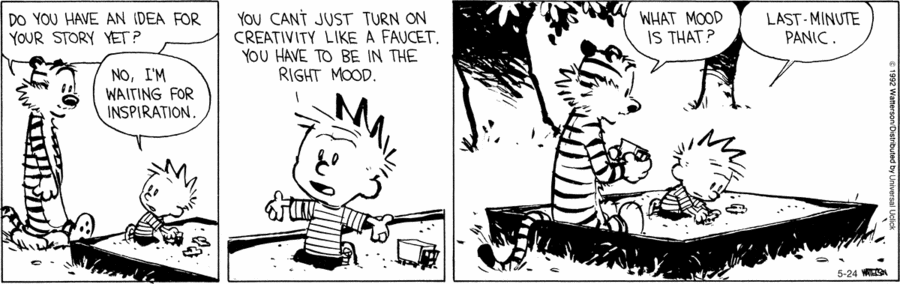
Mood

The mood of a person is the state of mind they are in at any given time. It might depend on their emotions or feelings. The mood of a place or thing is the atmosphere or feeling that it expresses.

1. If we say that someone is not a morning person, it could mean that they are generally in a bad mood in the morning. Do you know someone (or are you someone) who is often in a bad mood when they wake up?

2. When you are in a bad mood, how long does it last for? Are you able to change your "frame of mind" easily or does it usually affect your whole day?

3. Do you think "Seu Lunga" is always sarcastic because he's in a bad mood... or do you think he is sarcastic no matter what mood he's in?

4. When someone is unusually or unexpectedly happy, you could say to them, "Wow, you're in a good mood today!" Are people pleasantly surprised when you are in a good mood?

5. What situations or circumstances put you into a bad mood? When someone insults you? When it's a rainy day? When you're hungry or tired?

6. If someone is very temperamental and their emotions go up and down, you could say that person is "moody". Do you "wear your heart on your sleeve"? In other words do you let your emotions show easily?

Friday, May 9, 2014

Stand up to/ Stand up for


If you “stand up to” someone, you are defending yourself. If you “stand up for” something you are claiming your right or demanding fair treatment. To “stand up against” is to confront someone in defense of.

1.      Do you remember who sang the following song:
              “Get up, stand up, stand up for your rights…
              get up, stand up, don’t give up the fight.” ?
              http://www.youtube.com/watch?v=BiPwCMlghhQ

2.      It’s good to stand up for your rights, but we all need to “pick our fights”. It’s just not beneficial standing up for some rights we think we have, because sometimes they are really insignificant or unimportant and it’s not worth the conflict. Have you ever stood up for your rights by getting involved in a demonstration or protest?

3.      Sometimes it is good to stand up to a “bully”… and sometimes there are disastrous consequences, especially in the case of a smaller or weaker country standing up to a bigger country. Some people portray the USA as a bully. Do you think this is really the case?

4.       Mahatma Gandhi was a fascinating character. The way in which he stood up against discrimination in South Africa and in India using passive resistance and non-violence, makes him stand out as one of the most important examples of resolving conflict peacefully.

Tuesday, May 6, 2014

Out + Verb

If you outrun someone, you run faster than them. If you outplay your opponent, you play better than them. If you outfish someone, you catch more/ bigger  fish. 

1.      By far, my favorite TV series is a reality show called “Survivor”.  About 20 contestants are castaway on an island or isolated somewhere in the wilderness. The contestants are split into tribes and have to survive the elements, construct shelter, build fire, look for water, and scrounge for food and other necessities for the entire filming period which is around 39 days. The show uses a system of progressive elimination, allowing the contestants to vote off other tribe members until only one final contestant remains and wins the title of “Sole Survivor” and a million dollar cash prize. The slogan for the series is: “Outwit, Outplay, Outlast.” To become the Sole Survivor, one contestant has to be smarter, play better and last longer than everyone else.

2.      Children grow so quickly that they outgrow their clothes on a regular basis. Also you can outgrow something as you get older and more mature or get more experience. Have you outgrown your job?

3.      When it comes to speech recognition technology, Google is outperforming Apple’s assistant, “Siri”. On the other hand, however, it doesn’t actually do anything except search.  Google can tell you the height of the Golden Gate Bridge faster than Siri, but it can’t set appointments, take dictation, or make a phone call.

4.      When you do a phenomenal job with something or made more effort than usual, people can say that you have outdone yourself. London really outdid itself with the last Olympics. It was really first class!